Why Spot Coolers Matter in Industrial Cooling
The demand for efficient cooling systems is growing rapidly with the expansion of industrial facilities in India. Manufacturing plants and warehouses struggle with the heat buildup which impact productivity and the environment for the workers.
Spot coolers are proving to be an effective solution in such cases. Traditionally, HVAC systems used to cool the entire buildings but industrial spot cooling focuses on particular areas that require immediate cooling. Spot cooling has proved to be cost effective, energy efficient and highly flexible for applications in various industries.
However, still businesses fail to achieve the optimal performance due to various mistakes. These mistakes eventually lead to increased energy costs, reduced cooling efficiency and shortened equipment life.
Read More :- Cool Jet Systems – Advanced Cooling Solutions for Die Casting Efficiency
What is a Spot Cooler? (Simple Explanation for Beginners)
A spot cooler is a portable of fixed cooling system which is designed for targeted cooling of a specific area instead of centralised cooling.
What is Spot Cooling?
Spot cooling is basically a process of localized cooling of the area where heat generation is highest. It is commonly used when full-scale air conditioning is neither practical nor necessary.
How a Spot Cooler Works
A spot cooler pulls warm air from the surrounding, passes it over through cooling coils and releases cool air to the required area. This localized method of cooling improves efficiency while reducing the energy consumption.
Spot Cooling vs Traditional HVAC Systems
| Spot Cooling | Traditional HVAC |
| Cools specific areas | Cools entire building |
| Portable and flexible | Fixed installation |
| Lower operational cost | Higher energy consumption |
| Ideal for temporary needs | Best for permanent whole-building cooling |
Common Applications of Spot Cooling
- Factories
- Warehouses
- Data centers
- Server rooms
- Outdoor events
- Temporary industrial setups
The growing adoption of industrial spot cooling is driven by its flexibility and energy-saving benefits.
Read More :- A Complete Guide to Industrial Casting Machines in Modern Manufacturing
Types of Spot Coolers Used in Industry
Portable Industrial Spot Cooler
A portable industrial spot cooler is easy to move between workstations or production areas. Such coolers are perfect for temporary cooling needs.
Water-Cooled vs Air-Cooled Systems
Water-Cooled Spot Coolers
- Use water for heat removal
- Are more effective in high-temperature environments
- Are suitable for heavy industrial operations
Air-Cooled Spot Coolers
- Use ambient air for cooling
- Are easier to install
- Have lower maintenance
Now that you are familiar with the application and types of spot cooling systems, lets try to understand the mistakes that impact the effectiveness of these coolers.
Mistake 1: Choosing the Wrong Size Spot Cooler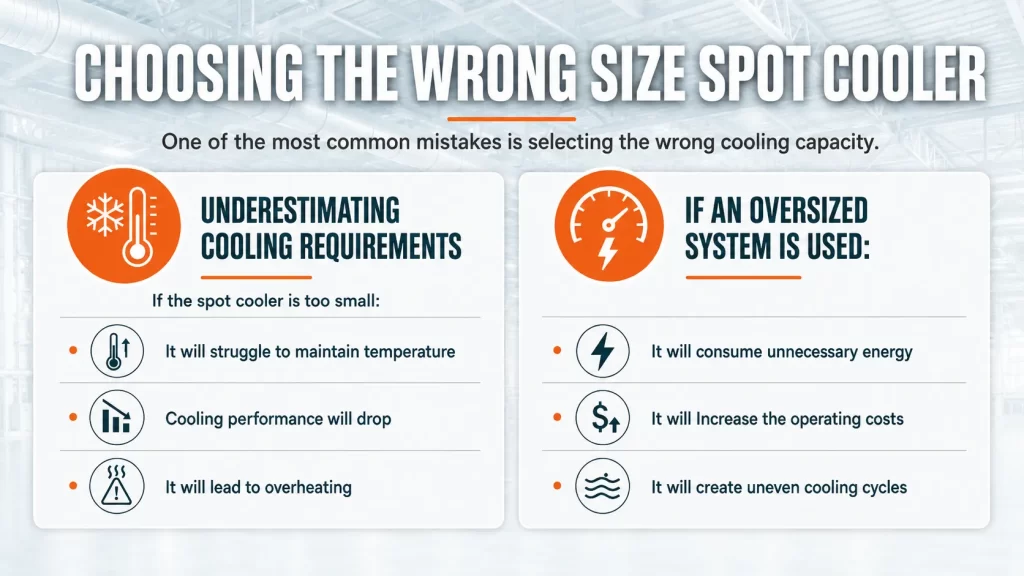
One of the most common mistakes is selecting the wrong cooling capacity.
Underestimating Cooling Requirements
If the spot cooler is too small:
- It will struggle to maintain temperature
- Cooling performance will drop
- It will lead to overheating
If an oversized system is used:
- It will consume unnecessary energy
- It will Increase the operating costs
- It will create uneven cooling cycles
Importance of Proper BTU Calculation
Before selecting a unit, calculate:
- Room size
- Heat generated by machinery
- Number of workers
- Ventilation conditions
Choosing the correct cooling capacity is essential for efficient industrial spot cooling.
Mistake 2: Ignoring Placement and Airflow Direction
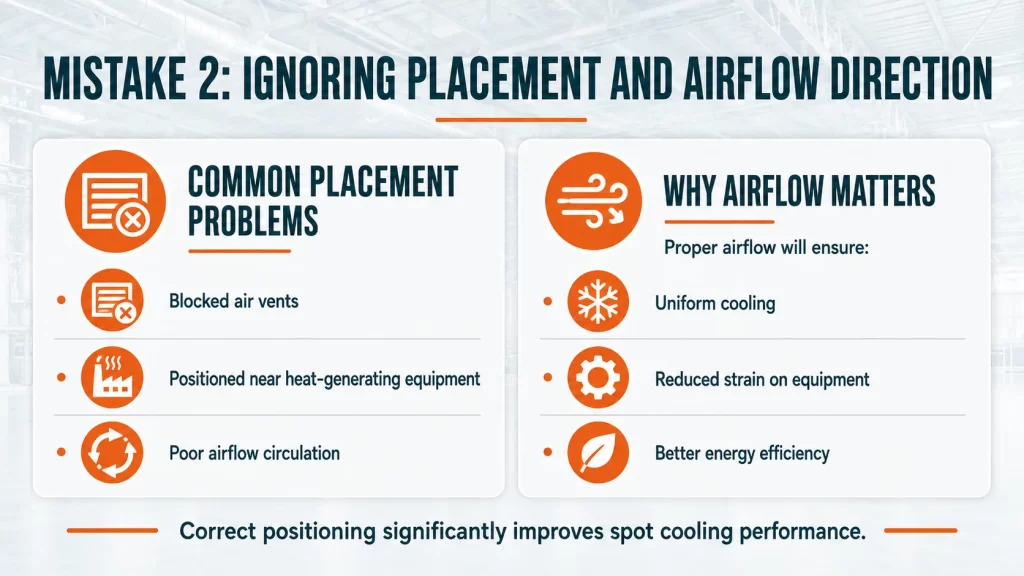
Common Placement Problems
- Blocked air vents
- Positioned near heat-generating equipment
- Poor airflow circulation
Why Airflow Matters
Proper airflow will ensure:
- Uniform cooling
- Reduced strain on equipment
- Better energy efficiency
Correct positioning significantly improves spot cooling performance.
Mistake 3: Not Considering Spot Cooler Rental Options
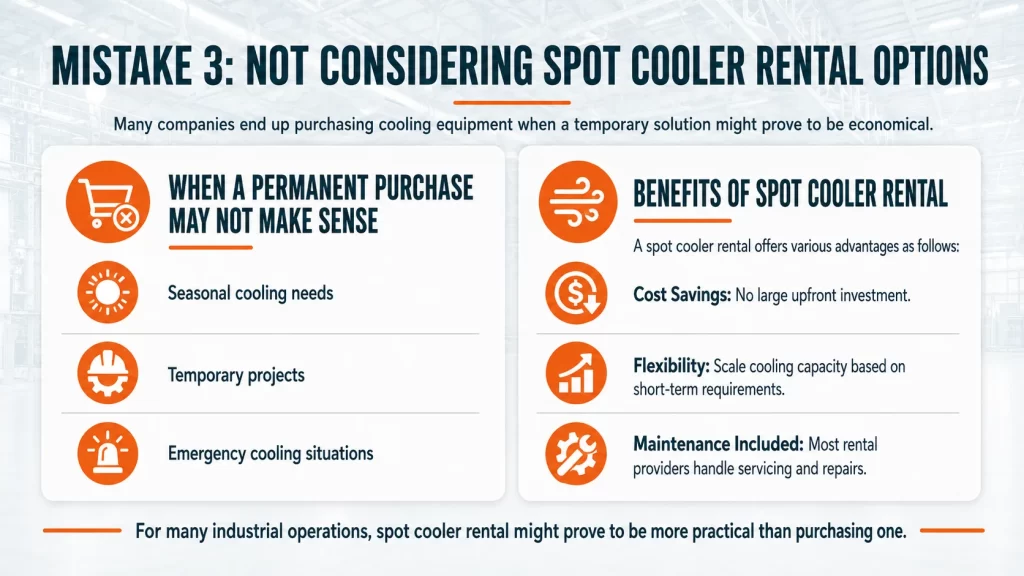
Many companies end up purchasing cooling equipment when a temporary solution might prove to be economical.
A permanent purchase may not make sense for:
- Seasonal cooling needs
- Temporary projects
- Emergency cooling situations
Benefits of Spot Cooler Rental
A spot cooler rental offers various advantages as follows:
- Cost Savings: No large upfront investment.
- Flexibility: Scale cooling capacity based on short-term requirements.
- Maintenance Included: Most rental providers handle servicing and repairs.
For many industrial operations, spot cooler rental might prove to be more practical than purchasing one.
Mistake 4: Neglecting Maintenance of Industrial Spot Coolers
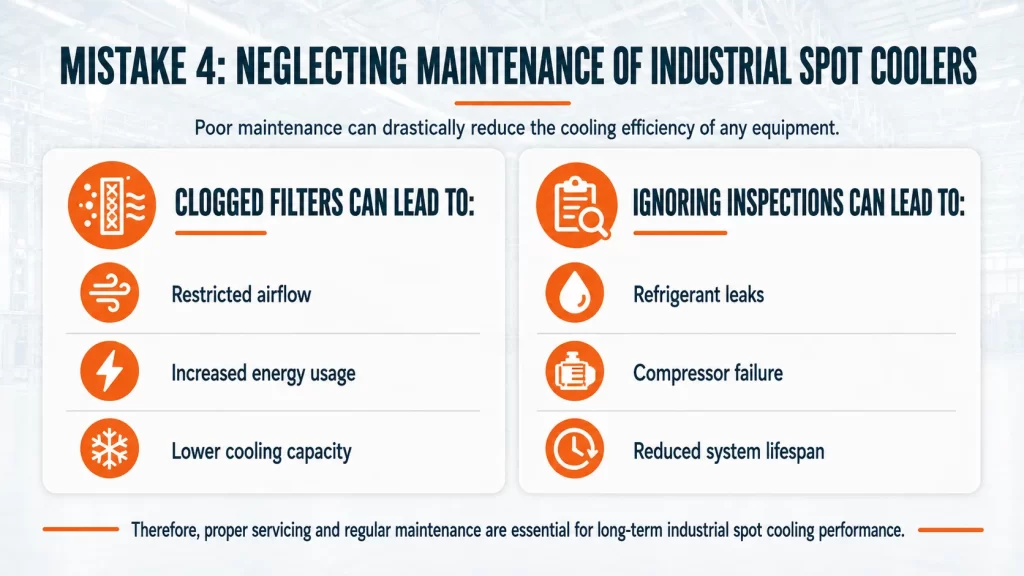
Poor maintenance can drastically reduce the cooling efficiency of any equipment. As, clogged filters can lead to:
- Restricted airflow
- Increased energy usage
- Lower cooling capacity
And ignoring inspections can lead to:
- Refrigerant leaks
- Compressor failure
- Reduced system lifespan
Therefore, proper servicing and regular maintenance are essential for long-term industrial spot cooling performance.
Read More:- Die casting for EV battery housings: The Role of VACMAX Vacuum Systems
Mistake 5: Choosing the Wrong Manufacturer or Supplier
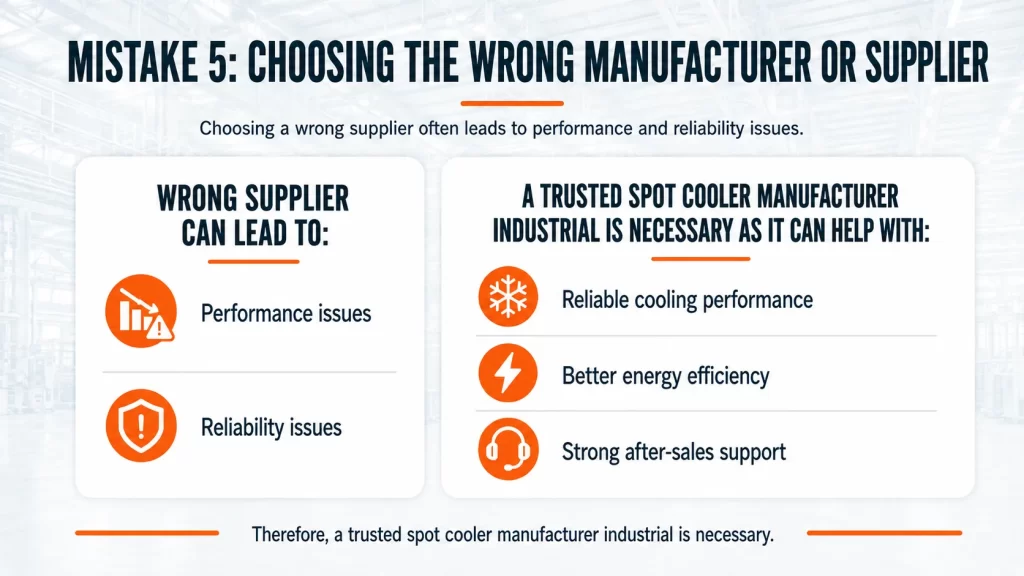
Choosing a wrong supplier often leads to performance and reliability issues. Therefore, a trusted spot cooler manufacturer industrial is necessary as it can help with:
- Reliable cooling performance
- Better energy efficiency
- Strong after-sales support
How to Choose the Right Industrial Spot Cooler
When selecting an industrial spot cooler, consider the following:
Cooling Capacity: Match BTU capacity with heat load requirements.
Energy Efficiency: Choose systems with high-efficiency ratings.
Portability: Consider whether the unit needs to move between locations.
Rental vs Purchase: Evaluate long-term operational needs before deciding.
Benefits of Proper Spot Cooling in Industrial Settings
Properly implemented spot cooling offers several advantages:
Improved Productivity
It creates comfortable working environments improve employee performance.
Equipment Protection
It prevents overheating of sensitive machinery and electronics.
Energy Savings
The targeted cooling reduces unnecessary energy usage.
Flexible Cooling Solutions
It is ideal for industrial environments with changing cooling demands.
Conclusion
A spot cooler can improve the overall cooling efficiency, reduce your downtime and lower the operational costs if used properly. But often, mistakes such as wrong size selection, poor placement, lack of maintenance or unreliable suppliers can impact the performance of the cooling systems.
Therefore, in order to maximize the benefits of industrial spot cooling, you should:
- Select the correct cooling capacity
- Ensure proper airflow placement
- Maintain the coolers regularly
- Consider rental options when appropriate
- Work with experienced manufacturers and suppliers
Still not sure?
Our experts can guide you through with the right consultation.
FAQs
What are spot coolers?
Spot coolers are portable or fixed cooling systems which are designed to cool specific areas instead of entire buildings.
Why is my spot cooler not cooling?
The most common reasons why your spot cooler is not working, include dirty filters, low refrigerant levels, blocked airflow, or incorrect sizing.
What is the difference between spot cooling and room cooling?
Spot cooling targets a specific area while room cooling conditions the entire room or the building.
What are the three types of cooling?
The common types of industrial cooling are air cooling, water cooling, and evaporative cooling.
What are spot coolers used for?
Spot coolers are used in factories, warehouses, data centers, temporary events, and industrial workspaces.
What is an industrial cooler?
An industrial cooler is a heavy-duty cooling system designed for manufacturing and industrial environments.
Do spot coolers require water?
Some water-cooled models require water, while air-cooled spot coolers do not.
How to improve cooling efficiency?
Improve airflow, clean filters regularly, position the unit properly, and maintain the system routinely.
What measures cooling efficiency?
Cooling efficiency is commonly measured using BTU ratings, EER (Energy Efficiency Ratio), and COP (Coefficient of Performance).
What is the maintenance of cooling equipment?
Cooling equipment maintenance includes filter cleaning, refrigerant checks, airflow inspection, and routine servicing of components.