Die casting is a manufacturing technique that entails pumping molten metal into a steel mold cavity under high or low pressure to produce intricate metal components with accuracy. This technique is extensively employed for manufacturing components in high quantities with uniform quality.
Central to this process is the die casting mold, a specially designed instrument that determines the quality, dimensions, and finish of each casting. In mould die casting, the mold (or die) significantly impacts manufacturing efficiency, component longevity, and overall cost-effectiveness. Thus, comprehending the types, design, and functionality of die casting dies is crucial for any producer.
Read More :- Die casting for EV battery housings: The Role of VACMAX Vacuum Systems
What is Mould Die Casting?
Process Overview
Mould die casting is categorized into two primary types:
High-pressure die casting (HPDC) involves the injection of molten metal at high velocity into the die. Compatible with aluminum, magnesium, and zinc alloys.
Low-pressure die casting (LPDC) involves the process of forcing metal into a mold using low pressure. Utilized for components that necessitate enhanced mechanical characteristics and increased wall thickness.
The mold, also referred to as a die, is a reusable steel tool designed with cavities that replicate the shape of the final component. In the casting process, the mold serves a dual purpose: it shapes the part and regulates the flow, cooling, and solidification of the metal.
Materials utilized in the process of mold fabrication: High-grade tool steels, such as H13 or P20, are recognized for their thermal resistance and strength.
Advantages of Mould Die Casting
- High dimensional accuracy: Ideal for tight tolerances.
- Excellent surface finish: Reduces post-processing.
- Rapid production cycles: Perfect for high-volume runs.
Industries using mould die casting:
- Automotive (engine housings, brackets)
- Electronics (casings, connectors)
- Aerospace (lightweight components)
- Consumer appliances
Components of a Die Cast Mold
- Cavity and core: Form the exterior and interior surfaces of the part.
- Cooling system: Maintains mold temperature and cycle time.
- Ejector pins: Release the casting from the die.
- Runners and gates: Channels through which metal flows into the cavity.
Mold Life & Maintenance
The lifespan of die cast dies is influenced by the specific metal alloy used and the prevailing operating conditions. Standard lifespan:
- Zinc: 100,000+ shots
- Aluminum: 50,000–100,000 shots
Effective cooling systems and consistent maintenance procedures , including polishing, inspection, and re-coating, contribute to the longevity of dies and minimize casting defects.
Read More :- Understanding Porosity in Casting: Causes, Types, Effects, and Prevention
Types of Die Casting Dies
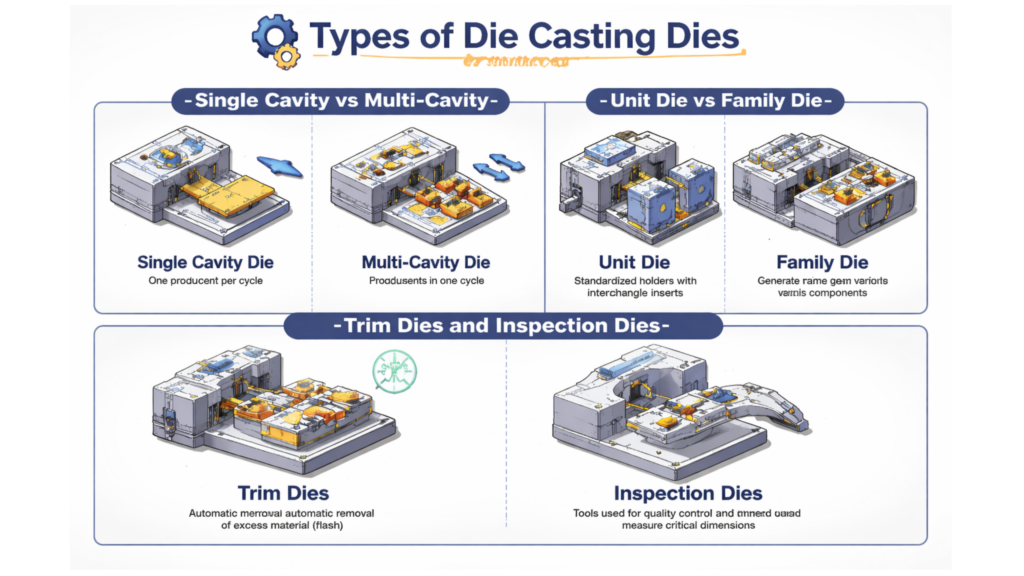
Single Cavity vs Multi-Cavity
- Single Cavity Die: Generates one component per cycle. Appropriate for prototype applications or low-volume production.
- Multi-Cavity Die: Produces several identical components in a single injection cycle. Enhances productivity and optimizes cost-efficiency.
Unit Die vs Family Die
- Unit Die: Employs standardized die holders that accommodate interchangeable inserts. Economically advantageous for recurring projects.
- Family Die: Generates various components within a single frame. This is beneficial for the assembly of component kits.
Trim Dies and Inspection Dies
- Trim Dies: Facilitate the automatic removal of excess material (flash) following the casting process.
- Inspection Dies: Utilized for quality control purposes and for measuring critical dimensions.
The die cast die types facilitate customization, automation, and quality control across diverse production setups.
Die Cast Die Manufacturing Process
Design Phase
- CAD design and simulation: Engineers use CAD tools and flow analysis to simulate metal behavior and optimize the mold.
- Prototyping: Soft tooling or 3D printing to validate designs.
Tooling and Machining
- CNC machining: Precision cutting of mold components.
- EDM (Electrical Discharge Machining): Enables intricate cavity details.
- Heat treatment and coating: Improves wear resistance.
Mold Testing and Tuning
- Trial runs: Detect any defects or flow issues.
- Thermal balance testing: Ensures uniform cooling.
- Production readiness: Final polishing and assembly.
Applications of Die Casting Molds
- Automotive: Gearboxes, engine blocks, steering components
- Consumer electronics: Laptop frames, battery enclosures
- Aerospace & medical: Lightweight brackets, diagnostic device parts
Die casting molds are essential for manufacturing complex parts at scale with reliability and speed.
Choosing the Right Mold for Your Project
Key Factors to Consider
- Tonnage: Required clamping force
- Material: Type of alloy being cast
- Complexity: Undercuts, thin walls, or inserts
- Production volume: Short-run vs long-term tools
Custom vs Standard Dies
- Custom molds: Ideal for unique part geometries and specialized applications.
- Standard dies: Useful for common part shapes and reduce lead time.
Common Challenges in Die Casting Tooling
- Thermal cracking: Caused by inconsistent cooling, solved with optimized flow paths and coatings.
- Flash formation: Fixed via precision die fit and trim dies.
- Shrinkage & porosity: Minimized through venting, gating optimization, and vacuum-assisted molds.
Future Trends in Die Casting Mold Design
- Simulation-based optimization: AI-assisted mold design and flow simulation tools.
- 3D printed inserts: For prototyping or low-volume production.
- Smart mold monitoring: Real-time temperature and pressure tracking to reduce downtime.
Conclusion
Mold design is fundamental to the effectiveness of mould die casting processes. A precisely designed die casting mold plays a critical role in shaping the part while also influencing its quality, durability, and production cost. Recent advancements in design and manufacturing processes have led to the evolution of die casting dies, providing manufacturers with enhanced control and improved efficiency.
Looking to enhance your mould die casting process with precision tooling and intelligent systems?
Contact Raga Group today to discover tailored solutions that elevate quality and productivity.
FAQs
What is the difference between mould die casting and injection molding?
Mould die casting involves the use of molten metal, whereas injection molding utilizes plastic materials. Die casting necessitates the use of metal dies and the application of elevated temperatures.
How long does a die casting mold last?
The lifespan is contingent upon the specific alloy and mold material, with a range of 50,000 to over 100,000 cycles observed.
Can one die cast die be used for multiple alloys?
Not ideally. Each alloy possesses distinct thermal and chemical properties; utilizing a die for various metals may compromise quality.
What materials are commonly used for die casting dies?
Tool steels such as H13, P20, and maraging steel are frequently utilized due to their exceptional heat resistance and hardness properties.
What are the key benefits of using high-quality die casting molds?
Improved surface finish, enhanced dimensional accuracy, extended tool life, and reduced defect rates.