Die casting is among the most important manufacturing processes for the production of high-volume metal components that require precise dimensional accuracy and surface finish. Automotive, aerospace, electronics and industrial machinery heavily depend on die casting for fast as well as cost effective production.
Better quality and faster production cycles are often in demand by the manufacturers and to meet that demand advanced cooling technologies are becoming essentially popular. One such innovation is jet cooling which is a cooling technique developed to have better control on mold temperatures during the die casting process.
Jet cooling technology is helping manufacturers achieve:
- Better product quality
- Reduced cycle time
- Higher manufacturing efficiency
- Lower defect rates
- Longer mold life
In order to understand how jet cooling works, it is necessary to understand what is die casting and how various kinds of die casting processes actually work.
So, let’s dive deeper.
Read More :- Aluminum Extrusion Dies: Process, Types & Applications
What is Die Casting?
Definition and Process Overview
Die casting refers to a manufacturing process where molten metal is injected into a hardened steel mold cavity under high pressure. After the metal solidifies, the mold is opened to remove the finished component.
This method of casting is not new, it has been used for ages for producing complex metal parts with:
- High dimensional accuracy
- Smooth surface finish
- Fast production speed
- Minimal machining requirements
Today, die casting is especially important in the mass production of components where consistency and efficiency are desirable.
Common Materials Used in Die Casting
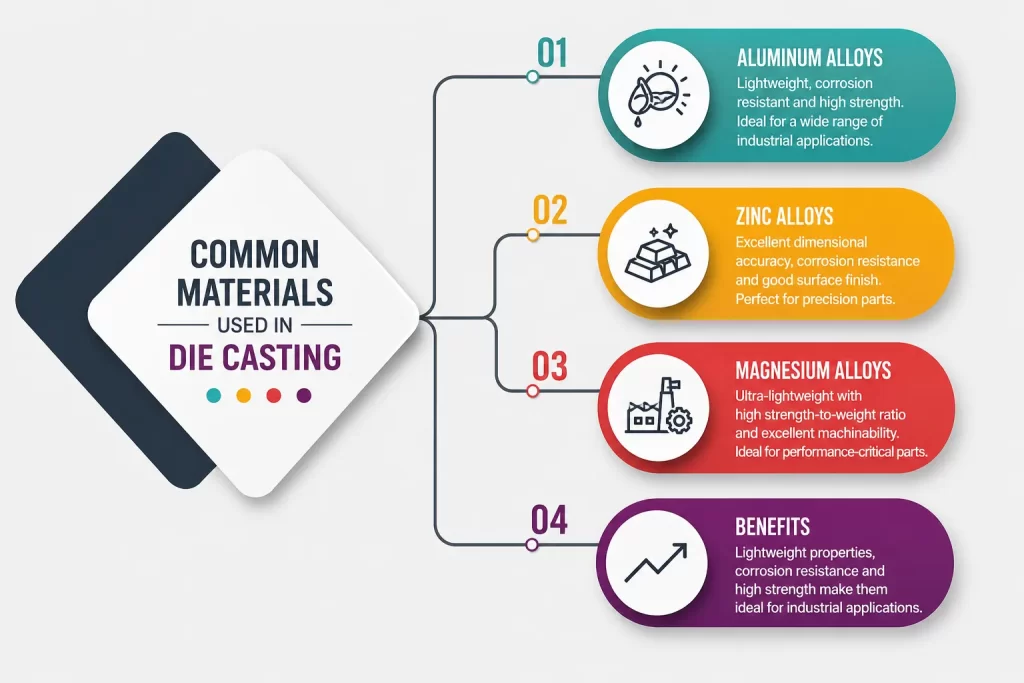
Various non-ferrous metals commonly used in die casting are:
- Aluminum alloys
- Zinc alloys
- Magnesium alloys
These metals are preferred as they offer lightweight properties, corrosion resistance and high strength which makes them suitable for industrial applications.
Die casting is also known as precision casting because it helps in the production of highly accurate components with minute details.
Types of Die Casting Processes
Hot Chamber Die Casting
Hot chamber die casting is a process in which the injection system is submerged directly in the molten metal. The metal is then drawn into a chamber and injected into the mold under high pressure.
Advantages of Chamber Die Casting
- It helps in achieving fast production cycles.
- It helps with getting higher efficiency.
- It lowers the risk of oxidation.
Limitations of Chamber Die Casting
- Die casting is not suitable for high melting point metals.
Suitable Materials for Chamber Die Casting
- Zinc
- Magnesium
- Lead Based Alloys
Hot Chamber Die Casting
In the case of cold chamber die casting, the molten metal is kept in a separate furnace and then moved into the injection chamber before it is injected into the mold.
This process is commonly referred to as:
- die casting cold chamber
- cold chamber die casting
When To Use This Process
Cold chamber systems are often used for metals that have high melting points such as aluminum and copper alloys.
How This Process is Different From Hot Chamber
In cold chamber systems, the injection mechanism is not submerged in molten metal as it is done in hot chamber. It reduces the equipment wear when working with alloys with high melting temperatures.
Read More :- Automation in Casting Process: Transforming Foundries with Smart Manufacturing
Hot vs Cold Chamber Casting
| Factor | Hot Chamber | Cold Chamber |
| Production Speed | Faster | Slightly slower |
| Suitable Metals | Zinc, magnesium | Aluminum, copper |
| Equipment Wear | Lower | Higher |
| Efficiency | High | Moderate to high |
| Cost | Lower operating cost | Higher due to external melting |
This key understanding of hot and cold chamber die casting can help manufacturers make the right choice of the process based on the material as well as the production requirements.
What is Jet Cooling in Die Casting?
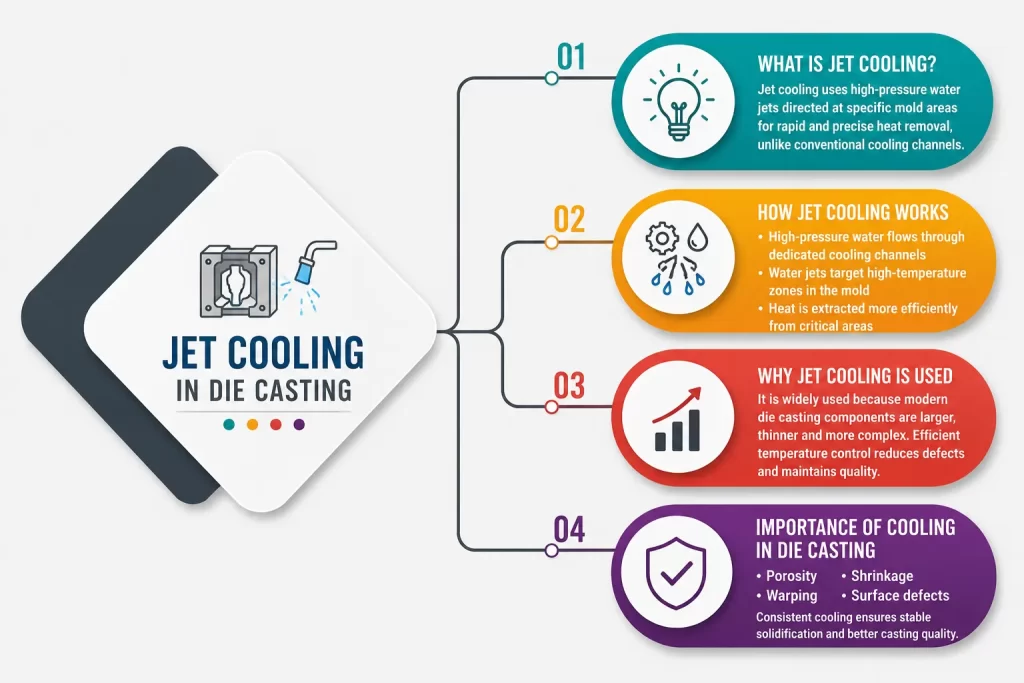
Jet cooling refers to an advanced mold cooling technology used in modern die casting systems. Unlike the conventional cooling channels, jet cooling make use of high pressure water jets which are directed at specific mold areas and core pins for rapid and precise heat removal.
How Jet Cooling Works
- High-pressure water flows through dedicated cooling channels
- Water jets target high-temperature zones in the mold
- Heat is extracted more efficiently from critical areas
The controlled targeted cooling improves thermal stability and helps achieve production consistency.
Why Jet Cooling Is Used
Jet cooling is being popularly used because modern die casting components are becoming larger, thinner and more complex.
As a result, efficient temperature control is required to maintain the quality by reducing the defects.
Importance of Cooling in Die Casting
Cooling plays a very important role when it comes to die casting as cooling has the following impacts on the product quality:
- Porosity
- Shrinkage
- Warping
- Surface defects
Consistent cooling ensures stable solidification and better casting quality.
How Jet Cooling Improves Quality
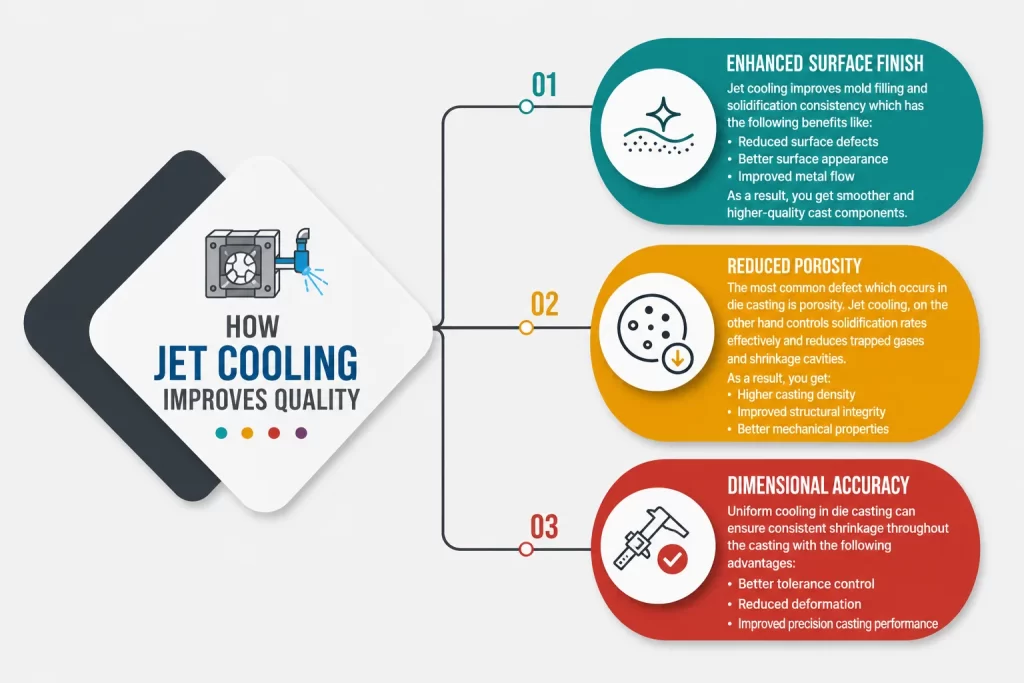
Enhanced Surface Finish
Jet cooling improves mold filling and solidification consistency which has the following benefits like:
- Reduced surface defects
- Better surface appearance
- Improved metal flow
As a result, you get smoother and higher-quality cast components.
Reduced Porosity
The most common defect which occurs in die casting is porosity. Jet cooling, on the other hand controls solidification rates effectively and reduces trapped gases and shrinkage cavities.
As a result, you get:
- Higher casting density
- Improved structural integrity
- Better mechanical properties
Dimensional Accuracy
Uniform cooling in die casting can ensure consistent shrinkage throughout the casting with the following advantages:
- Better tolerance control
- Reduced deformation
- Improved precision casting performance
How Jet Cooling Improves Efficiency
Faster Cycle Times
Jet cooling helps in the removal of heat rapidly from critical mold areas. The benefits of which are as follows:
- Shorter cooling duration
- Faster mold opening
- Increased production output
Using the jet coolers in their die casting manufacturers can significantly improve machine productivity.
Energy Efficiency
Optimized cooling with jet coolers can reduce unnecessary energy consumption and can:
- Lower operational costs
- Reduce water usage
- Improve thermal efficiency
Increased Mold Life
Excessive thermal stress can damage molds over time. But jet cooling stabilizes mold temperatures and minimizes:
- Thermal fatigue
- Cracking
- Wear and tear
This extends the mold service life and reduces maintenance costs.
Jet Cooling in Cold Chamber Die Casting
Jet cooling offers major advantages in cold chamber die casting applications such as:
- Faster heat extraction for aluminum alloys
- Improved solidification control
- Reduced cycle time
In cold chamber die casting systems, high-temperature metals create intense thermal loads and jet cooling helps solve the problems such as:
- Uneven cooling
- Core pin overheating
- Shrinkage porosity
Application of Jet Cooling:
- Automotive structural parts
- Engine housings
- Transmission components
- Industrial machinery parts
Challenges and Considerations
Although jet cooling offers various advantages but the manufacturers should also consider:
- Higher initial investment
- Maintenance of cooling systems
- Complex mold design requirements
Because, proper system integration is important for long-term success.
Future Trends in Die Casting Cooling Technologies
Modern die casting is evolving rapidly with the emerging trends such as:
- Automated cooling systems
- AI-driven temperature control
- Smart monitoring technology
- Sustainable cooling solutions
Advanced thermal management systems are becoming essential for Industry 4.0 manufacturing environments.
Conclusion
Jet cooling is transforming modern die casting by improving both product quality and manufacturing efficiency. Jet cooling has to offer many advantages to the manufacturers such as reduced porosity, improved surface finish, faster cycle times and extended mold life.
As the demand for lightweight and high-performance components is growing, the right cooling strategy will become increasingly important for competitive manufacturing.
FAQs
What is jet cooling?
Jet cooling is a cooling method that uses high-pressure targeted water jets to rapidly remove heat from die casting molds.
What is the purpose of cooling channels within the die in die casting?
Cooling channels help regulate mold temperature, improve solidification control, and reduce casting defects.
What are the 5 main parts of the cooling system?
Typical cooling systems include:
- Cooling channels
- Pumps
- Heat exchangers
- Control valves
- Monitoring sensors
What are the two methods of cooling?
The two common cooling methods are:
- Conventional channel cooling
- Jet cooling
What are the different types of die casting process?
The main types of die casting processes are:
- Hot chamber die casting
- Cold chamber die casting
What are the four types of casting?
The four common casting methods include:
- Sand casting
- Die casting
- Investment casting
- Gravity casting
What are 5 safety rules for casting?
The following safety rules should be followed while casting:
- Wear protective equipment
- Handle molten metal carefully
- Maintain cooling systems properly
- Avoid moisture near molten metal
- Follow machine operating procedures
How to increase cooling efficiency?
Cooling efficiency can be improved through:
- Jet cooling systems
- Optimized cooling channel design
- Real-time temperature monitoring
- Proper mold maintenance