
Die Casting Procedure: Step-by-Step Guide to the Complete Die Casting Process
Die casting is a high-precision manufacturing technique that involves injecting molten metal under high pressure into a specially made mold or die to create intricate metal components. This process is highly regarded for producing parts with consistent quality, precise dimensions, and superb surface finishes.
This guide offers a thorough explanation of the die casting process, including all of the necessary steps from beginning to end.
What is Die Casting?
Overview
Melted metal is pushed under intense pressure into a steel mold cavity during the die casting process. The die, also called a mold, is made to precisely create complex parts.
Common metals used in die casting:
-
Aluminum
-
Zinc
-
Magnesium
Applications of Die Casting
Die casting is commonly used in:
-
Automotive parts (engine blocks, transmission housings)
-
Consumer electronics (laptop frames, mobile phone casings)
-
Aerospace components
-
Power tools and industrial hardware
Types of Die Casting Processes
Hot Chamber Die Casting
Ideal for low-melting-point metals such as zinc and magnesium.
The injection mechanism is submerged in molten metal.
Faster cycle times due to shorter melting-to-injection paths.
Cold Chamber Die Casting
Used for high-melting-point metals like aluminum and copper-based alloys.
Molten metal is poured into the injection chamber before being forced into the die.
Better suited for metals that would corrode the internal components of a hot chamber machine.
Die Casting Procedure – Step-by-Step Breakdown
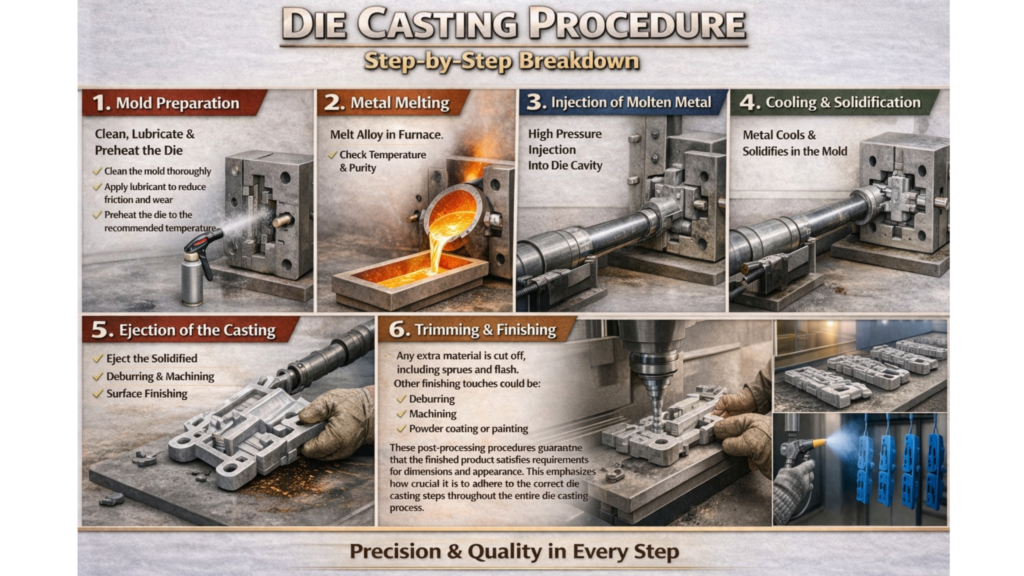
Step 1 – Mold Preparation
The die is cleaned and lubricated prior to casting in order to guarantee smooth metal flow and avoid sticking. Additionally, the mold is preheated to enhance metal flow and lessen thermal shock.
Step 2 – Metal Melting
In a furnace, the selected metal alloy is melted until it reaches the necessary casting temperature. To prevent flaws, consistency and purity are constantly checked.
Step 3 – Injection of Molten Metal
High pressure is used to inject the molten metal into the die cavity, filling in even the smallest details. Until the metal solidifies, the pressure is kept constant.
Step 4 – Cooling and Solidification
The metal solidifies into the mold’s shape as it cools. Part size, wall thickness, and material all affect cooling time.
Step 5 – Ejection of the Casting
The part is forced out of the mold by ejector pins when the die opens after the metal has solidified. Robotic arms can be used for handling and ejection in automated systems.
Step 6 – Trimming & Finishing
Any extra material is cut off, including sprues and flash. Other finishing touches could be:
-
Deburring
-
Machining
-
Powder coating or painting
These post-processing procedures guarantee that the finished product satisfies requirements for dimensions and appearance. This emphasizes how crucial it is to adhere to the correct die casting steps throughout the entire die casting process.
Quality Control in Die Casting
To ensure quality, the following inspections are carried out:
-
Visual and dimensional inspection
-
Non-destructive testing (X-ray, ultrasonic)
-
Surface analysis
-
AI and automated systems are increasingly used for real-time defect detection.
Common Challenges in the Die Casting Procedure
-
Die Wear: Frequent use causes erosion and cracking; regular maintenance is required.
-
Porosity: Caused by gas entrapment during injection; resolved through vacuum-assisted casting.
-
Cold Shuts or Incomplete Fillings: Addressed by optimizing injection speed and die design.
Advantages of Following the Correct Die Casting Steps
-
Fast and efficient mass production
-
Exceptional accuracy and repeatability
-
Minimal post-processing
-
High mechanical strength and integrity
Conclusion
The quality and functionality of the finished product are greatly influenced by each step in the die casting process. Following the right die casting steps guarantees maximum output, less waste, and happier customers.
Need expert help with die casting? Contact us for a consultation or quote today.
FAQs
1. What are the steps in the die casting procedure?
Mold preparation, metal melting, injection, cooling, ejection, and trimming are the primary processes.
2. What is the difference between hot and cold chamber die casting?
Low-melting metals are processed more quickly in a hot chamber. Aluminum and other high-temperature alloys perform better in a cold chamber.
3. How long does each step of die casting take?
Cycle times vary, but depending on the size and complexity of the part, they usually range from 30 seconds to several minutes.
4. What materials are used in the die casting process?
The most widely used alloys are magnesium, zinc, and aluminum because of their strength and castability.
5. Why is pressure important in die casting steps?
By guaranteeing that the molten metal fills the mold entirely, high pressure minimizes flaws and captures fine details.
