One of the most popular materials in contemporary manufacturing is aluminum alloy. They are perfect for a variety of applications due to their special blend of strength, light weight, corrosion resistance, and castability.
Aluminum alloy for casting continues to drive innovation across industries, from consumer electronics and industrial machinery to automotive and aerospace. Everything you need to know about aluminum casting alloys, their characteristics, casting techniques, and how to select the best aluminum casting die for your project is covered in this guide.
What is Aluminium Alloy for Casting?
Definition and Properties
Engineered combinations of aluminum with additional elements such as silicon, copper, magnesium, and zinc are known as aluminum alloys for casting. In contrast to pure aluminum, these casting-grade alloys provide improved strength, fluidity, and corrosion and heat resistance.
Key Properties:
- Lightweight and strong
- Excellent thermal and electrical conductivity
- High corrosion resistance
- Superior castability and surface finish
Common Types of Aluminium Casting Alloys
- 3xx.x Series (Al-Si-Cu or Al-Si-Mg): Excellent strength and corrosion resistance balance. Frequently found in industrial and automotive parts.
- 4xx.x Series (Al-Si): High silicon content improves wear resistance and fluidity.
- 5xx.x Series (Al-Mg): Provides good weldability and corrosion resistance.
- 7xx.x Series (Al-Zn-Mg): Very high strength but less commonly used in casting.
| Alloy Series | Strength | Fluidity | Machinability | Corrosion Resistance |
| 3xx.x | High | Medium | Good | Excellent |
| 4xx.x | Medium | Excellent | Fair | Good |
| 5xx.x | Low | Fair | Poor | Excellent |
| 7xx.x | Very High | Low | Moderate | Moderate |
Benefits of Aluminum Casting Alloys
- Exceptional mold filling and dimensional accuracy
- Ideal for thin walls and complex shapes
- High production efficiency and cost-effectiveness
- Excellent surface finish
- 100% recyclable, supporting sustainability goals
Aluminum casting alloys enable scalable production without compromising part quality.
Types of Casting Methods for Aluminium Alloys
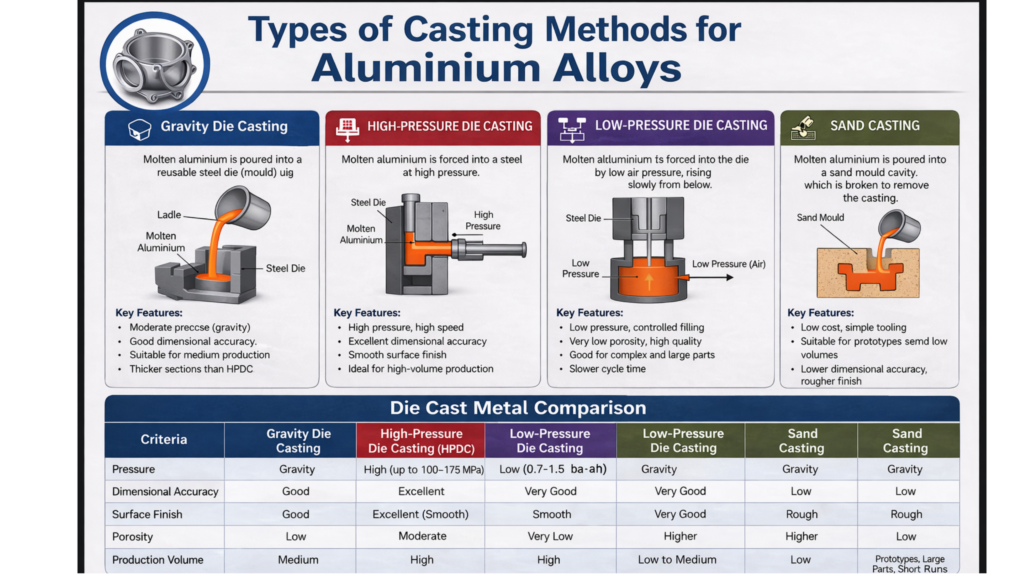
Gravity Die Casting
Melted aluminum is poured by gravity into a reusable metal mold. Good dimensional control makes it appropriate for medium-volume production.
High-Pressure Die Casting (HPDC)
High pressure and speed are used to inject molten aluminum into a die. This process provides superior surface finish and dimensional accuracy, making it perfect for mass production. Needs a sturdy aluminum casting die.
Low-Pressure Die Casting
Low pressure is used to force molten metal into the mold. is utilized for structural components and offers superior mechanical qualities.
Sand Casting
Sand molds are filled with melted aluminum. Large, low-volume parts are the best fit. Compared to die cast metal processes, it is more flexible but has less dimensional precision.
Die Cast Metal Comparison:
- Aluminum: Lightweight, corrosion-resistant
- Zinc: Better for intricate parts
- Magnesium: Extremely lightweight but expensive
Role of Aluminum Casting Die in the Process
What is an Aluminum Casting Die?
A precision mold composed of premium tool steel, such as H13, that can withstand high temperatures and pressures during the casting process is called an aluminum casting die. Die cast metal die life is greatly increased by proper heat treatment and upkeep.
Custom vs Standard Dies
Custom Dies:
- Tailored to unique part geometries
- Higher initial cost, better long-term ROI
Standard Dies:
- Lower cost, limited flexibility
Modular Designs: Allow quick changeovers and reduce downtime in production.
Choosing the Right Aluminum Alloy for Your Application
Factors to Consider
- Strength & Ductility
- Corrosion Resistance
- Operating Temperature
- Machinability
- Budget
Industry-Specific Recommendations
- Automotive: ADC12, A356 (good fluidity, cost-effective)
- Aerospace: A357, 319 (lightweight with high strength)
- Consumer Goods: 443.0, 360 (aesthetic finishes, good corrosion resistance)
Challenges in Aluminum Casting Alloys
- Porosity and shrinkage defects
- Mold and die wear from thermal fatigue
- Alloy consistency and contamination
- Precision machining for complex parts
Innovations in Aluminum Casting Alloys
- Development of heat-resistant, high-strength alloys for EV and aerospace.
- Simulation software for predicting alloy behavior under casting conditions.
- Use of 3D printed molds to accelerate prototyping and reduce tooling costs.
Conclusion
Producing high-performance components requires selecting the proper aluminium alloy for casting and the appropriate aluminum casting die. Manufacturers can now achieve increased sustainability, efficiency, and precision thanks to developments in die cast metal technology and alloy development.
Are you trying to find high-quality aluminum casting solutions?
Get in touch with us right now.
Frequently Asked Questions (FAQs)
Which aluminium alloy is best for casting?
Because of their strength, fluidity, and resistance to corrosion, alloys such as ADC12, A356, and A380 are frequently used.
What is the difference between aluminum casting alloys and forging alloys?
Forging alloys put mechanical strength and ductility first, whereas casting alloys are made for fluidity and mold filling.
How long does an aluminum casting die last?
Typically 75,000–200,000 shots depending on the alloy, complexity, and maintenance.
Is aluminum a good die cast metal?
Yes, it offers excellent strength-to-weight ratio, castability, and corrosion resistance.
5. What are the typical applications of die cast aluminum components?
Engine housings, electronic enclosures, heat sinks, gearboxes, and structural automotive parts.