The casting process is an important part of manufacturing as it produces complex and high strength components. Casting helps to achieve precision to scale whether it is used for automotive engine blocks or industrial machinery parts.
However, the casting quality not only depends on molten metals or molds but heavily relies on the small components like the core pins. These small ye significant elements help in achieving geometrical accuracy and structural integrity.
As a result, even minor mistakes in core pin can often lead to major casting defects, rejections and even increased production costs. Let’s break down the 5 horrible mistakes you might be making with core pins and how to fix them.
What is the Function of Cores in the Casting Process?
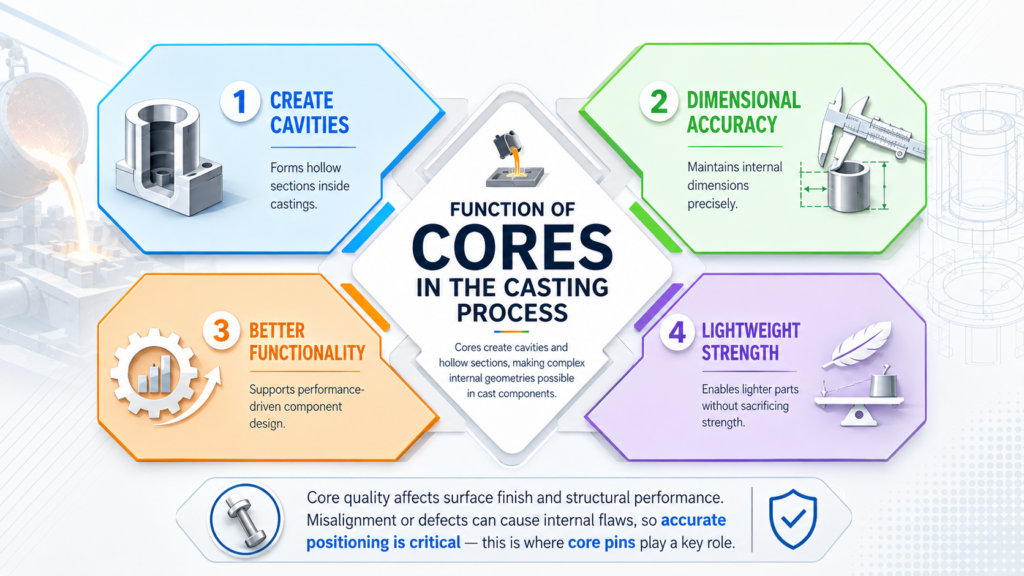
Before jumping on to the issues related to core pins, its important to first understand the function of cores in the casting process.
A core is used to create cavities or hollow sections in casting and without cores it is impossible to manufacture components with complex internal geometries.
Key Functions of Cores:
- To create cavities in casting.
- To maintain internal dimensions accurately.
- To improve the product functionality.
- To enable lightweight strong designs.
Cores can directly impact the surface finish and structural performance. Any misalignment or defect in cores leads to internal flaws that make positioning critical and this is where core pins come into play.
Read More :- Aluminum Extrusion Dies: Process, Types & Applications
What are Core Pins in Casting?
Core pins are components used to support, locate, and secure cores inside the mold cavity during the casting process.
Role of Core Pins:
To maintain accurate positioning of cores
To ensure mold stability during pouring
To prevent core movement due to molten metal pressure
To improve dimensional consistency
Materials Used:
In most common applications, steel core pins are used due to:
- High strength
- Heat resistance
- Durability
Using high-quality core pins is important for maintaining consistent casting quality.
Types of Cores in Casting
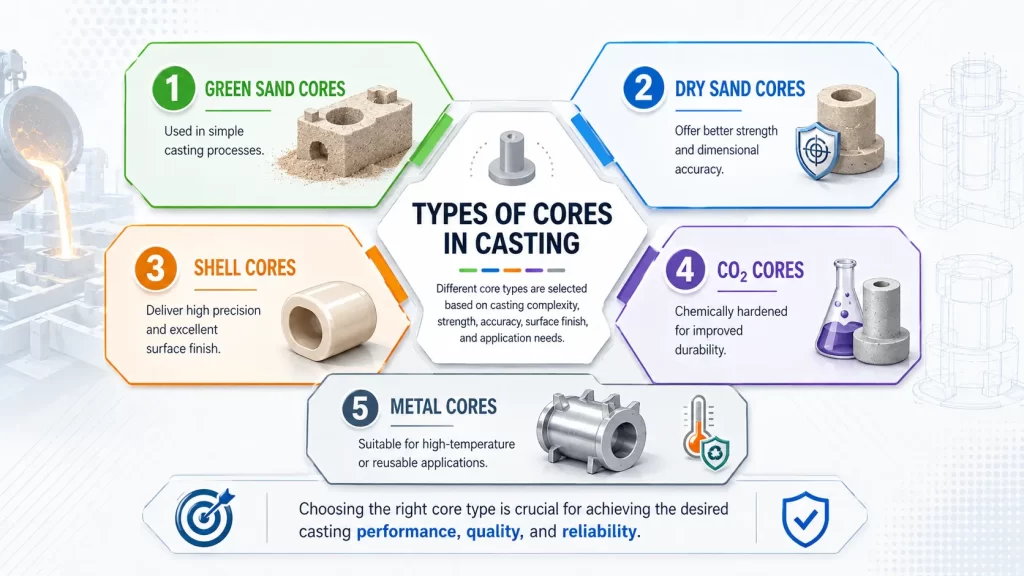
There are several types of cores in casting depending on the application:
- Green Sand Cores: Used in simple casting processes
- Dry Sand Cores: Offer better strength and accuracy
- Shell Cores: High precision with excellent surface finish
- CO₂ Cores: Chemically hardened for improved durability
- Metal Cores: Used in high-temperature or reusable applications
The choice of right type of core is quite crucial for achieving the desired performance in casting.
Read More :- Choosing the Right Die Casting Manufacturer: Aluminum, Alloys, Machines & More
Core Print in Casting: Why It Matters
A core print in casting is a feature in the mold that supports and positions the core accurately.
Why Core Print is Important:
- It ensures correct alignment of cores.
- It prevents shifting during pouring.
- It maintains dimensional accuracy.
A poorly designed core print leads to defects such as misalignment, uneven walls, or internal cavities.
Core Making in Casting Process
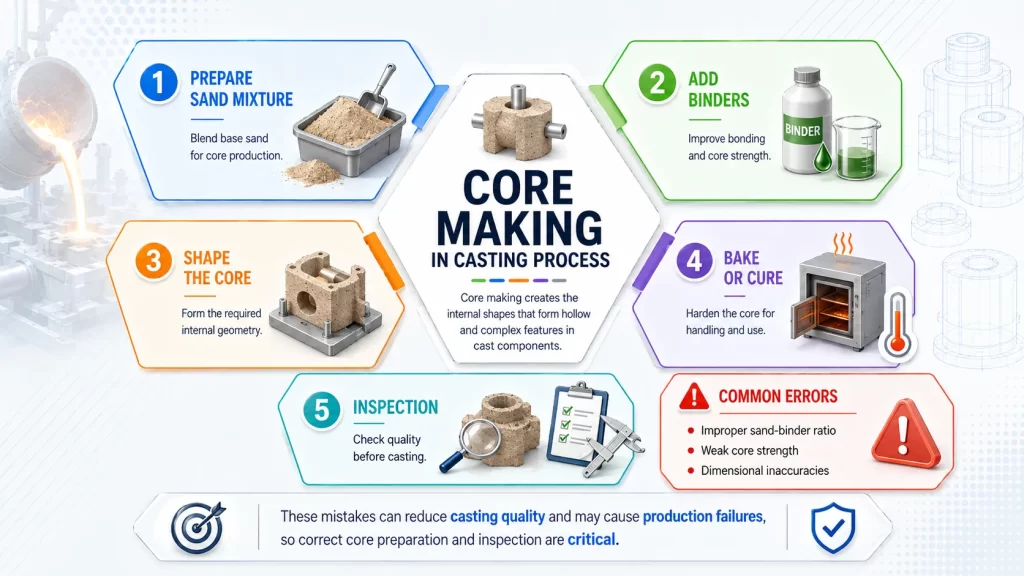
The core making in casting process involves creating cores that will shape internal features of the casting.
Steps in Core Making:
- Preparing sand mixture
- Adding binders for strength
- Shaping the core
- Baking or curing
- Inspection before use
Common Errors:
- Improper sand-binder ratio
- Weak core strength
- Dimensional inaccuracies
These mistakes can directly impact casting quality and lead to failures during production.
Read more :- Why is detecting “Core Pin Breakage” critical to avoid serious accidents? How to implement it in HPDC.
The Core in Centrifugal Casting is Made of…
In centrifugal casting, the concept is slightly different. The core in the centrifugal casting is made of refers to materials used to withstand rotational forces and high temperatures.
Common Core Materials:
- Graphite
- Ceramics
- Heat-resistant alloys
Why It Matters:
- It must withstand extreme heat
- It should maintain shape under rotation
- It needs to have high durability
Compared to traditional casting, centrifugal casting demands stronger and more heat-resistant core materials.
5 Horrible Mistakes You Are Making with Core Pins
Let’s get straight to the real issues that are impacting your casting quality.
Mistake 1: Incorrect Core Pin Alignment
Misaligned core pins can lead to uneven wall thickness, internal defects and dimensional inaccuracies.
Mistake 2: Using Low-Quality Steel Core Pins
Low-grade steel core pin materials result in faster wear and tear, breakage under heat and frequent replacements.
Mistake 3: Poor Core Print Design
A weak core print in casting causes core shifting, structural defects and increased rejection rates.
Mistake 4: Wrong Core Material Selection
Incorrect types of cores in casting can lead to poor surface finish, reduced strength and thermal failure.
Mistake 5: Improper Core Installation in Mold
Incorrect installation results in misalignment during pouring, core displacement and production losses.
How to Avoid Core Pin Failures
You can avoid these mistakes through a combination of design, material selection, and process control.
Best Practices To Be Followed:
- Use quality core pins made from durable materials
- Ensure precise alignment during installation
- Design robust core prints
- Select appropriate core types based on application
- Implement strict quality control in core making in casting process
Maintenance Tips:
- Regular inspection of steel core pins
- Replace worn-out pins before failure
- Monitor thermal stress and wear
Proper planning and execution can significantly improve casting efficiency and reduce defects.
Conclusion
Although, core pins are small components but their role in casting quality is massive from alignment issues to material selection.
Manufacturers can improve their product quality and reduce rejections by understanding the function of cores in the casting process and can avoid the common mistakes as mentioned above. Investing in the right design, materials, and processes ensures long-term success in casting operations.
Contact us for more information.
FAQs On Core Pins
What is a core pin used for?
Core pins are used to position and support cores inside molds during casting process.
What is a core pin?
It is a precision component that aids in accurate placement of cores in the mold.
What is core and types of core?
A core creates internal cavities in cast parts and the core types include sand cores, shell cores, CO₂ cores, and metal cores.
What are common ejector pin problems?
The common ejector pin problems include wear, misalignment, and breakage due to high thermal stress.
What are the 4 types of moulding?
The four types of moulding are sand moulding, injection moulding, compression moulding, and blow moulding.
What is meant by core in casting?
A core is a pre-shaped material placed in a mold to create hollow sections in a casting.
What is the core in the centrifugal casting is made of?
Core for centrifugal casting is typically made up of graphite, ceramics, or heat-resistant alloys.
What are the three types of centrifugal casting?
The three types of centrifugal casting are true centrifugal casting, semi-centrifugal casting, and centrifuging.
What are common defects in centrifugal castings?
The common defects in centrifugal castings are porosity, segregation, and uneven thickness.
What is a core print in casting process?
It is a mold feature that holds and positions the core.
What are the different types of cores used in casting?
The types of cores used in casting are green sand, dry sand, shell, CO₂, and metal cores.
What are the 10 materials used in casting?
Iron, steel, aluminum, copper, zinc, magnesium, bronze, brass, nickel alloys, and titanium.