
Giga Casting Thermal Management: Solving Stress in Mega Dies
The Shift: From Over 100 Parts to One Giga Casting
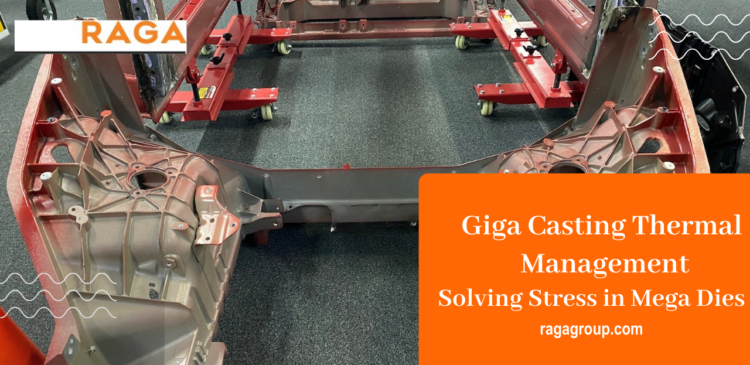
The global automotive industry is undergoing a structural transformation. Traditional vehicle architectures that relied on over 100 stamped and welded components are rapidly being replaced by single, massive aluminum castings popularly known as Giga or Mega Castings. A widely cited example is the rear underbody casting of the Tesla Model Y, produced as one integrated structure instead of dozens of individual parts.
This shift brings undeniable benefits: fewer parts, lower assembly costs, reduced weight, and improved structural stability. However, it also introduces never seen before manufacturing challenges especially in thermal management.
The Challenge: Bigger Machines, Bigger Thermal Risks
Giga castings demand ultra high tonnage die casting machines, typically ranging from 6000T to 9000T and beyond. At this scale, the die size, shot volume, and heat input increase rapidly.
Thermal management is no longer a secondary or “support” process. It becomes the single most critical factor determining:
- Structural integrity
- Dimensional stability
- Cycle time
- Scrap rate
Thesis: Why Traditional Cooling Fails at the Giga Scale
Cooling strategies developed for 800T-1500T machines simply do not scale up. At Giga dimensions, traditional constant flow cooling systems fail to control heat effectively, leading to distortion, residual stresses, and unacceptable scrap.
To succeed, die casters must move toward process controlled, high velocity jet cooling systems such as RAGA NEXplus, specifically engineered for mega dies and giga castings.
The Scale Effect: Why 6000T+ Dies Are Fundamentally Different
Thermal Mass: Heat at an Unprecedented Scale
A 6000T+ die does not just generate more heat, it also stores more heat. The sheer thermal mass of the die steel and molten aluminum means:
- Heat dissipation takes significantly longer
- Localized hotspots persist across multiple cycles
- Temperature stability becomes extremely difficult to maintain
Without aggressive and targeted cooling, the die enters a state of thermal saturation, where every subsequent shot worsens the condition.
The “Core” Problem: Heat Trapped Where It Hurts Most
In mega castings, thick sections, deep ribs, and long core pins are unavoidable. These internal features trap heat in the center of the casting, far away from conventional cooling channels.
As a result:
- Core pins overheat
- Solidification becomes non-uniform
- Porosity and distortion increase dramatically
Thermal Lag: When Cooling Can’t Keep Up
Traditional cooling reacts too slowly to the massive heat spikes generated by giga sized shots. This creates a phenomenon known as thermal lag or heat soak, where:
- The die never fully cools between cycles
- Temperature keeps creeping upward
- The next shot starts from an already compromised thermal state
Why Traditional Cooling Fails for Giga-Sized Dies
Limitations of Drilled Cooling Channels
Conventional drilled water channels are often:
- Too far from the cavity surface
- Poorly positioned for complex geometries
- Incapable of addressing localized hotspots
In giga dies, this distance becomes fatal to thermal control.
Scaling and Clogging: Hidden Enemies
Large cooling circuits dramatically increase the risk of:
- Scaling due to poor water quality
- Partial or complete blockages
- Undetected flow reduction
Even a minor blockage can create severe temperature imbalance in a mega die often without immediate detection.
The Gradient Gap: Uneven Cooling, Uneven Stress
Traditional constant flow cooling creates:
- Cold zones near inlets
- Hot zones near outlets
In giga castings, these temperature gradients become extreme, inducing internal stresses that directly compromise dimensional accuracy and strength.
Structural Warping: The Silent Killer of Giga Castings
Residual Stresses from Non-Uniform Cooling
When different regions of a 1.5-meter plus casting cool at different rates, they contract unevenly. This leads to:
- Internal residual stresses
- Permanent warping
- Loss of dimensional tolerance
The “Nominal” Nightmare
In conventional assemblies, warped parts can often be adjusted during welding or assembly. In giga casting, there is no second chance.
If a single piece casting is out of tolerance:
- It cannot be corrected
- It cannot be reworked
- It becomes scrap
Multi-Thickness Constraint
Giga castings combine:
- Thin ribs
- Thick mounting points
- Structural reinforcements
Uniform cooling across such varied geometries is physically impossible using traditional cooling systems.
The RAGA NEXplus Solution: Advanced Jet Cooling for Mega Dies
What Is High-Velocity Jet Cooling?
High-velocity jet cooling works on a precisely controlled cycle:
- High-pressure water jet directly impacts the critical hot zones
- Rapid heat extraction occurs exactly where it’s needed
- Air purge removes residual water, preventing steam pockets or explosions
This targeted approach delivers instant thermal response, unlike passive cooling channels.
RAGA NEXplus USPs for Giga Casting
Multi-Zone Cooling Recipes
RAGA NEXplus can manage up to 10 independent cooling systems or heat zones, allowing:
- Thin and thick sections to be cooled differently
- Complete thermal balance across the die
- Recipe based control for different castings
Closed-Loop Precision
With integrated temperature and TDS control, RAGA NEXplus operates as a true closed-loop system, ensuring:
- Scale free cooling lines
- Consistent heat extraction
- Long-term system reliability
Core Pin Breakage & Leakage Detection
In 6000T+ machines, a broken core pin can lead to catastrophic water aluminum contact.
RAGA NEXplus is compatible with monitoring systems that detect:
- Leakage
- Blockage
- Breakage of individual core pins
Process Controlled Cooling
RAGA NEXplus transforms the cooling from a simple on/off utility into a PLC controlled, data-driven thermal strategy, synchronized with the casting cycle.
Business Impact: Beyond Physics
Cycle Time Reduction
Targeted jet cooling allows faster and safer ejection without warping, directly improving:
- Cycle time
- Machine utilization
- Overall Equipment Effectiveness (OEE)
Extended Die Life
By minimizing thermal shock and heat checking, RAGA NEXplus significantly:
- Reduces thermal fatigue
- Extends the life of expensive giga die sets
Scrap Rate Reduction
Dimensional instability is the leading cause of rejection in giga castings. Process controlled jet cooling eliminates this root cause, delivering:
- Higher first time right rates
- Lower scrap
- Predictable quality
Conclusion
Giga casting success depends on recognizing a fundamental truth: what works at 1000T does not work at 6000T+. Thermal physics scale non-linearly, and so must cooling technology.
Advanced, process controlled jet cooling such as RAGA NEXplus is not an optional add-on for giga casting It is the backbone of a stable, profitable, and scalable giga-casting production line.
Frequently Asked Questions
Q1: Why can’t I just increase the water flow in my existing cooling channels to handle Giga-sized dies?
A: Simply increasing flow doesn’t solve the problem of thermal lag. Giga-sized dies are so thick that by the time traditional water channels react, the surface has already overheated. Furthermore, at high temperatures, the Leidenfrost Effect occurs when a vapor layer forms inside the cooling lines that actually insulates the die, preventing heat extraction regardless of how much water you pump through. Advanced jet cooling like RAGA NEXplus uses high-pressure bursts to break this vapor barrier.
Q2: How does thermal stress specifically lead to warping in large single-piece castings?
A: In a 1.5-metre Giga-casting, different areas have different wall thicknesses. If a thick section remains liquid while a thin section solidifies, the resulting “thermal pull” creates internal residual stress. Without precise, zone-controlled cooling, the part will physically warp as it is ejected from the die. Because Giga-castings are designed for immediate assembly, even a 2mm warp can render the entire part and the massive amount of alloy used as scrap.
Q3: Is high-pressure jet cooling safe for 6000T to 9000T Giga Presses?
A: Safety is the primary concern when mixing water and molten aluminum. On a Giga Press, a core pin breakage can be catastrophic. Systems like the RAGA Monitoring System and NEXplus are designed with “Poka-Yoke” (error-proofing) logic. They use flow-sensing and pressure-drop detection to monitor every single pin. If a breakage or leakage is detected, the system triggers an immediate alarm and can halt the machine before the next shot, preventing water-aluminum explosions.
Q4: How does RAGA NEXplus handle the “Scaling” issue often found in massive cooling circuits?
A: Scaling (mineral buildup) is the silent killer of die life. RAGA NEXplus features an inbuilt AquaControl unit that monitors TDS (Total Dissolved Solids) and temperature in a closed-loop system. By maintaining “Scale-Free” water chemistry, the system ensures that the narrow jet cooling lines never block, maintaining consistent thermal performance shot after shot.
Q5: What is the expected ROI when upgrading to advanced jet cooling for Mega-castings?
A: The ROI is typically seen in three areas:
- Cycle Time: Targeted cooling can reduce solidification time by 10-20%.
- Scrap Rates: A significant reduction in dimensional rejections due to warping.
- Tool Life: Extending the life of a multi-million dollar Giga-die by reducing “heat checking” (thermal fatigue). Many casters see the system pay for itself within the first few months of high volume production.
