
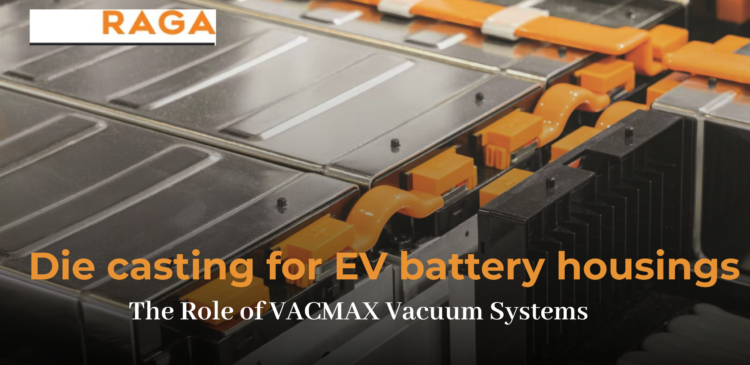
Die casting for EV battery housings: The Role of VACMAX Vacuum Systems
The shift from internal combustion engines to electric vehicles has redefined quality expectations in die casting.
In traditional IC engine components, a small amount of porosity might result in nothing more than a minor oil seepage. In EV battery housings, however, the same porosity can cause electrical short circuits, coolant ingress, thermal runaway, or even fires.
EV platforms introduce an “air-tight mandate.” Components such as battery trays, motor housings, and inverter enclosures must comply with IP67 or IP69K ratings, meaning they must remain completely sealed against dust, moisture, and high-pressure water.
The challenge is that traditional High-Pressure Die Casting (HPDC) naturally traps air during injection, creating gas porosity in EV housings, microscopic voids that act as invisible leak paths. This is where vacuum die casting for EVs becomes essential.
Why EV Components Are Truly Safety-Critical
Battery Enclosures
Modern die casting for EV battery housings goes far beyond containment. These housings act as structural crash members, absorbing impact loads while protecting high-energy battery cells. Any internal void can become a crack initiation point during a collision.
Motor & Inverter Housings
Motor and inverter housings often include integrated cooling jackets. Even a single through-pore can allow coolant to penetrate high-voltage electronics, leading to immediate system failure.
The Porosity Tolerance Gap
In conventional automotive parts, 2–3% porosity might be acceptable. In EV applications, near-zero porosity is required to pass air-leak decay tests, helium tests, and pressure bubble tests. This is the fundamental difference between standard casting and air-tight die casting.
The Science of Gas Porosity vs. Structural Density
Turbulence at Extreme Speeds
During HPDC, molten aluminum travels at 40–100 m/s. This high-velocity flow traps air inside the cavity much like a shaken soda can traps bubbles. Once solidified, these bubbles become gas porosity.
Structural Weak Points
Porosity is a structural risk. Voids act as stress concentrators where cracks initiate during vibration, fatigue, or impact loading, directly compromising motor housing structural density.
Why Venting Alone Is Not Enough
Manual venting or overflow design cannot adequately remove air from thin-walled, complex EV geometries. For EV-grade components, vacuum is the only reliable solution.
Enter VACMAX: Engineering the “Perfect Vacuum”
What Is Raga VACMAX?
Raga VACMAX is a high-performance two-stage vacuum system engineered specifically for high-integrity die casting applications, including EV battery trays, motor housings, and inverter enclosures.
Two-Stage Evacuation: The Critical Advantage
Unlike standard systems, VACMAX evacuates air from both the shot sleeve and the mold cavity.
- Stage 1: Air is removed from the shot sleeve before the fast shot begins.
- Stage 2: The mold cavity is evacuated during injection, ensuring minimal residual gas.
This prevents air from being pushed into the casting during metal flow, something single-stage systems cannot achieve.
Key Features of VACMAX for EV Casting Programs
High Vacuum Levels
VACMAX achieves the deep negative pressure required for T6 heat-treatable die castings, enabling high tensile strength and elongation essential for EV structural components.
Real-Time Monitoring & Traceability
The integrated HMI records vacuum curves for every shot, providing full traceability for OEM audits and EV quality compliance.
Reliable Hermetic Sealing
VACMAX integrates seamlessly with advanced vacuum valves to maintain a hermetic seal throughout the injection cycle, ensuring consistent air-tight die casting results.
Results: What VACMAX Delivers for EV Production
-
Elimination of Leak Paths
Consistently passing bubble tests and air-leak decay tests for EV housings.
-
Improved Mechanical Properties
Higher structural density allows thinner walls and light weighting without sacrificing strength.
-
Superior Surface Quality
Improved finishes in O-ring grooves, sealing faces, and gasket interfaces.
-
Dramatically Lower Scrap Rates
Typical rejection rates drop from ~15% to under 2% in high-integrity EV programs.
Conclusion
The EV market is unforgiving when it comes to quality. In this environment, vacuum die casting for EVs is mandatory.
To achieve air-tight die casting, structural density, and zero-leak performance, foundries must move beyond traditional HPDC practices.
Raga VACMAX enables manufacturers to bridge the gap from standard automotive castings to EV-grade excellence, ensuring safety, compliance, and long-term competitiveness in the electric mobility era.
FAQs
Q1: Why is vacuum die casting essential for T6 heat-treated EV parts?
In conventional die casting, trapped gas expands during heat treatment, causing surface blisters. Vacuum die casting for EVs using Raga VACMAX removes this gas, allowing safe T6 treatment and achieving the high strength required for EV structural components.
Q2: Can VACMAX handle giga-casting and large EV dies?
Yes. VACMAX is available with tank capacities up to 1000 liters and dual vacuum channels, designed for 3000T+ machines used in EV battery trays and motor housings.
Q3: How does two-stage vacuum differ from standard systems?
Standard systems evacuate only the mold. Raga VACMAX evacuates the shot sleeve first, removing a major source of trapped air before injection even begins.
Q4: Will VACMAX increase cycle time?
No. By reducing air backpressure, VACMAX often improves filling consistency and solidification, leading to stable or even reduced cycle times.
Q5: What leak-test success rate can be expected with VACMAX?
Most customers report a 90–95% reduction in leak-related rejections for pressure-sensitive EV motor and battery housings.
